

Power is not a purely social relation. It’s a metaphysical or categorial relation, out of which we then configure or construe better or worse social relations like domination, suffering, violence, contest, cooperation, love, friendship, enmity, misery, happiness, and malaise. Questions about whether a configuration is good or bad, better or worse, and why, will depend on many things: its consequences, its principles, its beneficiaries, its victims, the particular time, place, or flex of a form of power, and its role within a greater design, history, or social nexus. These questions can be endlessly disputed, day and night, and as a matter of fact, should be. No power is intrinsically good or bad, and no unsituated power can be deemed just or unjust, emancipatory or oppressive, productive or unproductive, democratic or undemocratic. Contrast this however with the popular and theoretical tendency to construe “power,” explicitly or otherwise, as domination— as pejorative, coercive, manipulative, excessive, merely as power-over— or likewise, to construe better-working configurations like democracy and egalitarianism as something other than power, if not its absence. The poppiest treatments of the topic, like Robert Greene’s sniveling self-help The 48 Laws of Power, are inevitably the most psychopathic, but to be honest, it’s not always better in the academy. The political theorist Robert Dahl tells us that: “my intuitive idea of power, then, is something like this: A has power over B to the extent that he can get B to do something that B would not otherwise do.” That is, he begins from a political theory of power which, defined by measurable contest, precludes consent or cooperation. What could possibly go wrong?
At the same time, power is also both popularly and theoretically associated with strictly political forms and institutions— that is, with “politics” in its more journalistic sense. If you casually drop the word “power” mid-conversation, as I’m inclined to do, people’s thoughts immediately leap to matters of state, or to the greater history of kingdoms and empires. Our images of power are deeply beholden to court and parliament. Curiously enough, though, these two preconceptions of power— both as domination and as state— put us in a funny spot. Together, as a syllogism, they imply that our political forms and organizations can never be more than varieties of domination; that we can never overcome or minimize domination, only produce different flavors of it. Political theory, then, only helps you pick your poison. This outlook plagues what is often referred to as the “realist” plank of modern political theory. Max Weber, who I consider to be on the softer side of realism, defined power (Macht) as “any chance within a social relation to impose one’s will also against the resistance of others, independently of what gives rise to this chance.” Scaled up to the political level, this means that the establishment of rule (Herrschaft) is little more than the institutionalization of domination, with authority looming above and obedience cowering below. As he says, Herrschaft is “the probability that a command with a given specific content will be obeyed by a given group of persons.” In this “scientific” understanding of power, legitimacy becomes the measure of compliance yielding to domination rather than of justice resisting it. Weber’s attitude toward domination gets more nuanced the further you wade into his work, but even this is partly due to a certain wobbliness in the English translation of “Herrschaft,” and partly due to a treacherousness in the general realist outlook, in which, ever since Thrasymachus, it’s been difficult to discern whether they’re describing, defending, or ironically decrying domination. Nevertheless, for the harder realists, however cooperative politics may appear or become, it remains at bottom pure struggle— Kampf— and usually in its nastiest, most violent and rivalrous sense, with peace and agreement achievable only in stalemate or acquiescence.
This feels less realist than it does tragic, a dark insistence that domination is a terrestrial constant only to be endured in different permutations. The best alternative, though, is not power-blindness. It’s not toxically-positive liberalism or staid functionalism, in which domination is merely a misunderstanding in need of deliberation or a technocratic problem in need of solution. The best alternative is a veritably dynamic theory that explains how different configurations of power “enhance capacities while minimizing domination,” and how various forms of power flex into shifting degrees and dimensions of domination, depending on how and where they’re put into operation. The point of critique, after all, is to distinguish better, healthier, and juster configurations of power from worse, crueler, and shittier ones, in both their positive and negative moments. What makes this so tricky, besides the contestability of domination itself, is that its forms are constantly innovating, conditions are continually shifting, goalposts are moving, tables are turning, and every manifestation of power is itself, even in any one moment, inherently ambivalent. In this section, I’m going to explain how this “ambivalence of power” follows from a dynamic metaphysics, in particular from our causal-modal definition of power, however much it runs against our habits of neatly cleaving the world into trust and suspicion, heroes and villains, helpful and harmful, useful and useless, and last but not least, good and evil. This doesn’t eliminate values but it does illuminate them. Power is ambivalent in every mode— political, economic, ideological, cultural, social— but for the time being, I’m going to focus on technical power, precisely in order to emphasize how this “ambivalence of power” (and its corollary, “abstract domination”) doesn’t rely on the social dimension of power, and isn’t merely the result of human error, folly, or frailty.
█
Read Leroi-Gourhan, Mumford, Simondon, Ellul, Stiegler, or Don Ihde. When these philosophers talk about “technics,” they don’t just mean technology. They’re not just talking about the gizmos: the windmills, combustion engines, birth control pills, Macbooks, coffee machines, or nuclear warheads. The term also encompasses social relations braided into technical objects and systems. The same goes for “technical power.” It comprises the total dynamics between tools and people, the technical dynamics between tools and tools, and the consequent social dynamics between people and people. The power of an automobile can include or involve all of the following: the automobile parts, the manufacturers, the mechanics, the drivers, the roads and highway systems, the highway and traffic police, the parallel public transport systems, the petroleum industry, the advent of self-driving vehicles, the principles of aerodynamics, and much, much more. It all depends on your scope. For the philosophers above, the scope gets pretty panoramic, so they usually try to break technics down into its increasing levels of extensive complexity: from tools and workers, to machines and operators, to technical systems and industries, until arriving at some total conglomerate of systems, such as the leviathan that Mumford dubbed the “Megamachine.” Or alternatively, they approach it through its degrees of intensive autonomy: from tools, to machines, to automated systems, to computational decision-making, culminating one day in the futurist feverdream of artificial general intelligence. Whatever their approach, they encourage us to understand technics in terms of interdependence and development— scientific, social, historical— rather than from the workshop and boardroom perspectives of engineering or entrepreneurialism. This is a welcome improvement, especially in the ethical void that is modern industry and research. However, by itself, it doesn’t amount to a dynamic philosophy of technics, one that understands developments and interdependencies fully in terms of powers rather than processes. A good, solid philosophy of technics will require an expert technical understanding (pace Martin Heidegger), in order to say how it all works and what specifically characterizes the technical. That being said, many of its unruliest gremlins only reveal themselves once we understand technics somewhat less technically, as another form or mode of power.
Tools are obviously a form of power. For all that obviousness, the dynamics of tools has long been obfuscated by the static-kinetic metaphysics underlying so much of technical thinking, as well as by the funny notion that tools, machines, and technical systems are but power-neutral objects until vicariously implemented by us power-happy humans. Lewis Mumford himself partly lapses into this when he sermonizes that “the machine itself makes no demands and holds out no promises: it is the human spirit that makes demands and keeps promises.” Here, I couldn’t disagree more. The machine itself does indeed make demands and hold out promises, merely in its own idiom. Yet the misguided idea that it doesn’t was one of the chief reasons it was chosen as a master metaphor for the natural world in early scientific modernity. Novatores like Galileo, Kepler, and Descartes were polemic in their rejection of Aristotle and teleology. They re-imagined the whole of nature as the gears and motions of a cosmic clock, wholly comprehensible in terms of forces, masses, and inviolable laws, without any need of the purposes or final causes of the Aristotelian worldview. One problem though: this new paradigm didn’t dispense with teleology in the way the Novatores had envisioned. The point of the new sciences was, after all, to understand the world, yet how could we understand a clock without understanding the purpose of time-keeping? If there was a machine in your kitchen or office, and you could describe how its parts moved, but had no fucking clue what it was for, would you honestly claim to understand it? If your coworker knew how the parts of a stapler fit together, but didn’t know how to use one, you’d probably think they were the boss’ idiot nephew, not a model of scientific learning. Mumford caught this gaff as well, but phrased it differently than I would: “By introducing the concept of a man-made mechanism, Descartes was secretly restoring those very subjective attributes: design, purpose, telos.” I don’t think of it as a question of subjectivity, because I don’t think purpose, or telos, depends on subjects. For me, it’s more the comic proposition that the natural world can be most meaningfully understood as a pointless machine.
You could try to salvage the metaphor by claiming, as many have, that the great cosmic mechanism does have an ultimate purpose, simply one known only to its Maker. This is a defensible position, but little help to us mortals, since in most mechanistic philosophies, the world itself remains locked in step by the chains of causal necessity. This means that, even if our spirits were free and self-determining, we’d never be able to impose our plans onto the causally necessary or divinely predetermined processes of the world around us. We could imagine but never act, seized in a state of metaphysical paralysis. Few of the early mechanists really took this to heart. Undeterred, they proclaimed that causal necessity could somehow be “guided” or “harnessed” for the benefit of humanity, which to me sounds a bit like installing a steering wheel on a freight train. Do we harness an animal to go wherever it was going anyway? Conversely, if it’s true, and our technologies and experiments are actually steering causal processes toward our own desired ends, then it’s hard to see how we could still seriously claim they’re necessary or predetermined.
For the sake of consistency, you could always double-down on determinism and dismiss any and all intervention as illusory, as later mechanists like La Mettrie or Baron d’Holbach vehemently did. However, by doing so, you’d be both denying the technological prometheanism of the new sciences and rendering their master metaphor incoherent. For if the world’s a machine (of the sort that natural philosophers trained their concepts on), then the world is a tool, and tools are utterly incomprehensible in terms of causal determinism (or even what’s characterized as “mechanistic processes”). Metaphysically, what distinguishes a tool from an object is its possible uses, an open possibility directly at odds with determinism. Just like the mystery machine in your kitchen or office, if you could only describe the physical qualities of a tool, or how its parts worked together, then you would only understand it as an object, and as a tool only once you grasped, however vaguely, its possible uses and failures. If you still want to insist that the cosmos is causally determined, then by definition, it can’t be a machine— of any sort. Sorry, buddy, you gotta get yourself a new metaphor.
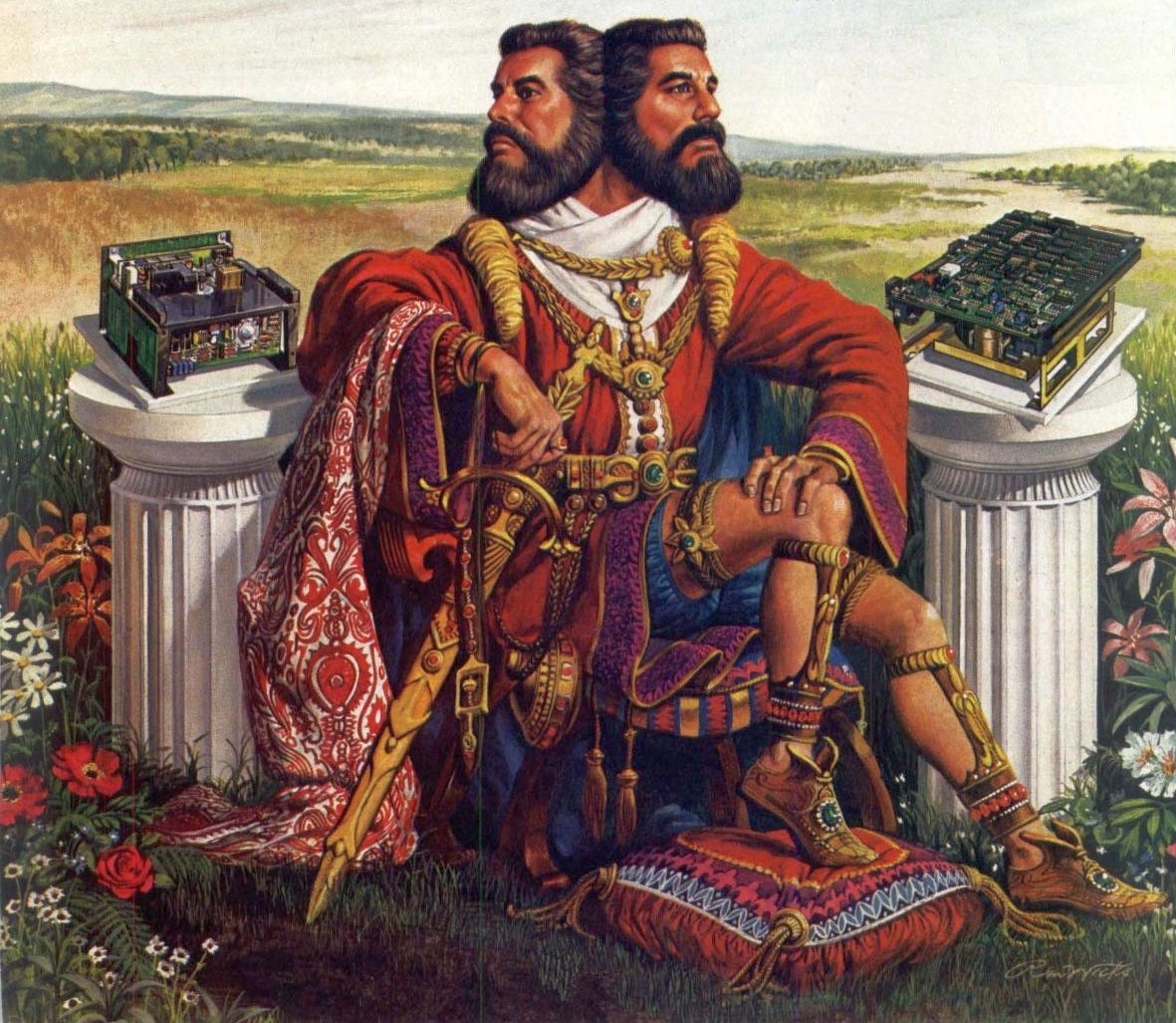
This means that the natural philosophers, perhaps unwittingly, were offering the public a confusing and flatly contradictory programme. Free human control and causal determinism were mutually exclusive. Nevertheless, this didn’t stop them from becoming the twin promises of Western scientific modernity. This wasn’t due to some split between science and technology, because there ain’t no such a split. Science draws its concepts from technology as much as technology instantiates scientific concepts. The two are conjoined twins, only now trying to travel in opposite directions. One of its heads was the virgin-autist Isaac Newton with the immutable laws of his Principia and Optics. The other was the slick-talking salesman Francis Bacon with his Novum Organon and New Atlantis, promising that the natural sciences would usher in “the enlargement of the bounds of humane empire.” This was quite the pitch. Bacon was eyeing not only utility and betterment, but world domination. Mumford weighs in to say:
“Behind all Bacon’s expectations, however, there was a little-noted factor that was to mark the inauguration of an age committed increasingly to the pursuit of science and the perfection of machines: an ambition for conquest that coincided with a growing sense of power which the machines already in existence, particularly cannon and firearms, had greatly stimulated. According to Bacon, there are three kinds of human ambition. The first is that of extending one’s personal power in one’s own country—the ambition of princes, lords, soldiers, merchants. The second is the increase of the power of one’s country over other countries— more dignified than the first, according to Bacon, but not less covetous and selfish. Finally, there is the ambition to enlarge the power and the dominion of the human race “over the universe of things.” This last seemed to Bacon a more disinterested and noble ambition than the other two, for “the empire of man over things depends wholly on the arts and sciences.”
These were the kind of quotes that had later critics, both inside and outside the scientific community, accusing Bacon of crass utilitarianism, of a perversion of science that led to the dehumanizations, exploitation, colonialism, and endless wars of expansionist Europe. For some defenders of the new sciences, this perversion could be absolved by renewing vows to a “more disinterested and noble ambition,” by separating the “pure” from the “applied” sciences, or the sciences from technology, or most improbably, knowledge from power. It wasn’t enough for science to merely disavow Bacon’s blares for global domination. It had to go and swear off “utility” altogether. Some suggested that it follow the lead of that purest, that least worldly, of all scientific disciplines: mathematics, which naturally aligned with divine contemplation in theological rationalists like Leibniz and Newton, or best of all, in the number theory of actual monks like Marin Mersenne. But was this “pure” mathematics actually without utility? It depends on what we mean by “utility,” I guess. It’s a word with contradictory definitions. One meaning of utility is having a predefined function, such as a key that only opens one door, or when we insult someone as “utilitarian” to call them dreamless. In this sense, sure enough, pure mathematics has no utility, no predefined functions to serve, and so much the better for it. But if “utility” just means “usefulness,” as it does in most lexicons, then the utility of pure mathematics was boundless. There was no limit to what you could do with it. Pureness then was a surplus, not an absence, of utility.
History bears this out with regard to Marin Mersenne. In 17th century France, Mersenne’s arcane investigations into prime factorization might have struck his contemporaries as fairly useless, or useful only insofar as it offered a glimpse into the unfathomable mind of God. Three centuries on, though, and number theory became one the bases of computational cryptography, a branch of mathematics so useful it’s been militarized and guarded at the highest levels as a state or corporate secret. Coming from the other direction, recall that Cardano, Fermat, and the devoutly Jansenist Pascal didn’t devise the foundations of probability in an act of sheer mathematical epiphany. They were trying to solve problems related to that most disinterested of all human activities: gambling. Nonetheless, these same probabilistic concepts later became a cornerstone of quantum physics, in order to, once again, offer us a glimpse into the unfathomable. It just goes to show, no matter how pure mathematics might get, at no point does it ever detach itself from our power-laden world. And if this is true for mathematics, it’d be rash to believe it’s any different for the this-worldy natural sciences. There were plenty of metaphysical and scientific treatises in early modernity that spoke about “powers” (specifically “causal powers”), but most of the time these weren’t supposed to be the same kind of “powers” that appeared in the social and political treatises. They were sharply distinguished, especially by the chad-disenchanters of the Enlightenment, for whom the social sense of power had no place in an impersonal cosmos. Stones could have mass and position. They could have qualities and quantities. They could be acted upon by laws and forces. They didn’t have power though— not in the same sense as courts and parliaments. My contention is that they do indeed have power in the same sense, the sense of power as composed by cause and possibility, that extends from the king of kings to the merest things of his kingdom.
█

To see what I mean, we need to review some simple ideas we have about causes and things. For this, we’ll return to a time long, long ago, before human society blemished the face of the earth. Imagine, if you will, a boulder upon a cliff sometime in the Precambrian era. There it has rested for untold eons, when suddenly, one day, it’s shaken from its perch and rolls down the cliffside, into a cluster of rocks in the valley below, sending them asunder like a set of bowling pins. A classically Newtonian event. In this story, the boulder plays the protagonist. Its motion is the cause; and the scattering of the rocks, the effect. This is a completely true story. The boulder did have a “causal power,” the force of its momentum, which was transferred to the rocks below, like the passing of a baton. However, there’s another telling, still in tune with Newton, though less intuitively Newtonian. In the telling of stories, minds are like eyes. They tend to follow motion. They prefer discrete, punchy, proximate actions. And so in our first intuition, causation seems to “flow” in one direction from the boulder to the rocks below. However, in this scenario, it’s no less true to say that the rocks in the valley were the cause and the boulder was the effect, that the arrows of causation “flowed” from the rocks to the boulder. After all, the rocks in the valley caused the boulder to stop, lightly chipping its edges in the collision. That is, they transferred their stillness, and the causal powers of that stillness, to the boulder all while subtly leaving their mark. Instead of ascribing the operative forces to the potential energy of the boulder, to the gravitational advantage of its height upon the perch, we could equally describe the positional advantage of the rocks in the valley, closer to the Earth’s center, which beckoned the boulder into their midst. Both accounts are simultaneously and equally true. The arrows of causation go both ways. Even in this simplest of Newtonian stories, the causal powers of both boulder and rocks work reciprocally upon each other.
Reciprocity isn’t just a restatement of Newton’s Third Law of Motion, which tells us that “for every action, there is an equal and opposite reaction.” For one, it undermines any clean distinction between actions and reactions, but more significantly, it means that for any event, action, or process, everything involved is always both a cause and effect. This is nothing original. Strictly as a causal model, some version of this has been banging around for a while in disciplines like cybernetics and systems theory. Common sense has, little surprise, been slower to catch on. Reciprocity runs against several habits of mind, such as the tendency to seek out “first causes,” not just in the lofty Aristotelian sense of an unmoved mover, but of any kind: metaphysical, temporal, or local. There’s nowhere to naturally start and nothing to fully blame. This can be maddening when settling feuds or misunderstandings, but this “bidirectional” or “multidirectional” causality helped science get a steadier grip on the slippery, emergent, chaotic phenomena of our world, even allowing for the “upward” and “downward” causation between different levels and scales of any system. Beyond this, reciprocity also works between radically different kinds of causes (and hence different modes of power). Thus even when we’re speaking about Newton’s Third Law of Motion, reciprocity demands that we ask how the boulder and the rocks in the valley affect the “Laws of Nature.” How do they affect gravity? How do they affect inertia? To put it more gently, how are these “laws” (whether causal powers or mere regularities) caused or conditioned by the things they supposedly govern, even if in some collective sense?
Without a natural starting point, causal stories (like the power accounts built upon them) will begin in media res and proceed as choose-your-own-adventures guided by questions of coherence, salience, and relevance. In conventional practice, science tends to proceed cautiously, sticking with very empirical and uniform kinds of causes. Metaphysics, not so much. It’s freer to follow out reciprocity into what you could think of as “omnidirectionality.” You’ll find this in some of the more avant-garde anti-mechanistic metaphysics, such as certain varieties of 19th century “ontologies of organism” (or organicism) and 20th century “ontologies of computation” (such as cybernetics). It also characterizes the causal nexus of Buddhist metaphysics, in the conception of “mutual arising” or “dependent origination” (paticca samuppada in Pali, or pratitya samutpada in Sanskrit), in which causal reciprocity expands all the way out into a cosmic holism, in which absolutely everything is causally linked to everything else, and which mutually supports other pillars of Buddhism like “impermanence” (the wholesale denial of static metaphysics) and “emptiness” (the wholesale denial of ontology).
As cool as these causal models are, they’re not in and of themselves dynamic. They’re just complex. Dynamism requires that our causal models be integrated with a modal dimension of possibility. Both cause and possibility are needed to combine into the full gradient of power. To get a better handle on the “ambivalence of power,” I’m going to consider them in turn, because ambivalence has two aspects; one having more do with its causal dimension, the other, with its modal or possibilistic dimension. Along the causal dimension, the ambivalence hinges upon reciprocity. Just as causation is never “flowing” in one direction, but always both directions at once, accordingly so too is power, even in the most asymmetrical power operations (whether it’s between people and tools or between lords and bondsmen). Power always works in both directions because the causes that constitute it are always reciprocal (a dynamic that underpins what Don Ihde calls the “non-neutrality” of technics). Along the modal or possibilistic dimension, the ambivalence of power is a result of what we’ll call “pleotropy,” a term borrowed from biology by the metaphysician George Molnar, and that I borrow in turn, slightly altered in meaning. It’s a weird word, but the concept behind it is more widely accepted than reciprocity (Ihde uses the similar term “multistability” when speaking about the pleotropy of technics). Etymologically, pleotropy means “more or many ways,” and the basic interpretation of this is that every cause has many possible effects. More evocatively, it means that every set of causes is like a fountain ever-flowing with both actual and possible effects.
Bringing this back to technics, I’ll set up yet another scenario, only this time in a period in which humans busily roamed the Earth. I could begin with the advent of tools among early hominids, like Leroi-Gourhan, but will fast-forward a bit to Mesopotamia, right before the rise of the Sumerian Empire, to establish an appreciably social context for the interpretation of tools. What were these guys working with? Well, all kinds of tools, but let’s go with a simpler category like blades: the knife, the axe, the plow. Clearly, blades empower their users. Their sharpness and strength supplement the causal powers of our bare hands, enabling us to cut or puncture things we otherwise couldn’t. Their form and basic properties change very little or very slowly in use. Despite this simplicity, their possible uses range widely. Primarily, blades can cut or part anything softer than themselves: wood, fruit, hair, soil, cloth, and flesh, whether human or animal. Their properties condition without wholly determining their use; the connection of causes to effects is pleotropic, with one set of causes branching out into an incalculable spread of possible effects. By “incalculable” I don’t mean just very large. I mean, quite literally, that possibility can’t be formulated as a sort of calculus among predeterminable options, a forking path or flowchart between causes and various effects. It’s open-ended, not multiple-choice. It’s possibility in a dynamic sense, not in the static-kinetic approximation of possibility as either probability or contingency. Pleotropy entails a nimbus of possibilities, not a fixed menu, and the reason I’m fond of this word is because the “pleo-” prefix means more than just “multiple.” It connotes an excess, a flowing over, too many or too much to be counted or contained. Aside from slicing and violence, the knife or dagger can also be used to point, scratch a back, clean fingernails, prop open doors, juggle or play games, impress women and passers-by, write in the sand, trade for other goods — the list is inexhaustible because the whole manifold of possibilities is itself pliant. It gets even wilder when we realize that the ambivalence of tools lies not just in their immediate physical actions, but in the social interpretation of these actions. The archaeological record backs this up. As Mumford attests:
“In the forest that stretches from the crown of the mountain seaward the hunter stalks his game: his is possibly the oldest deliberate technical operation of mankind for in their origin the weapon and the tool are interchangeable. The simple hammerhead serves equally as a missile: the knife kills the game and cuts it up: the ax may cut down a tree or slay an enemy.”
Deleuze and Guattari, likewise, write in Milles Plateaux:
“A distinction can always be made between weapons and tools on the basis of their usage (destroying people or producing goods). But although this extrinsic distinction explains certain secondary adaptations of a technical object, it does not preclude a general convertibility between the two groups, to the extent that it seems very difficult to propose an intrinsic difference between weapons and tools. The types of percussion, as defined by Andre Leroi-Gourhan, are found on both sides. ‘For ages on end agricultural implements and weapons of war must have remained identical.’”
This convertibility is pleotropic: the causes are identical; the effects, multifarious. The tool becomes a weapon not by physical alteration, nor even by drastically different physical actions, but through differing social relations to beneficence and violence. This ambivalence was the pivot upon which cities and empires arose in ancient Mesopotamia, where entire constructive and agricultural systems were alternatively used for the gains of productive growth and the spoils of destructive war. Likewise, as critics have observed, the same productive systems that in one sense liberated us from scarcity and toil, whether in the agricultural turn or the industrial revolution, were very often quickly commandeered as apparatuses of coercion and control. However, every productive system will always carry this threat of counter-productive employment, and in proportion to its very productivity. This is no cause for despair, nor evidence for the dour techno-pessimism you find in everyone from Martin Heidegger to Ted Kaczynski. Wholly to the contrary. The ambivalence of power refutes by definition both Heidegger’s techno-quasi-essentialism (“The essence of modern technology lies in Enframing. Enframing belongs within the destining of revealing. Where this ordering holds sway, it drives out every other possibility of revealing”) and the Unabomber’s techno-determinism (“if the system survives, the consequences will be inevitable: There is no way of reforming or modifying the system so as to prevent it from depriving people of dignity and autonomy”). Taken to heart, the ambivalance of power should also instill in us an ambivalence of mood, in which we refrain from betting the house on either pessimism or optimism, or attributing destinies to devices or any other form or system of power.
█
Causal reciprocity means that, in every relation, even between just two things, each will be both a cause and an effect of the other. Translated into terms of power, as a composite of cause and possibility, this means that in every relation, even just between two things, each exerts some form, mode, or measure of power upon the other. Power moves inevitably in both directions: whatsoever enables likewise constrains. In technical terms, as the tool, machine, or system serves us, it simultaneously puts differing demands upon us, often demanding more and more, until the point at which we’re more in its service than it is in ours. Not only is it a double-edged sword, we can’t always be sure which side is the handle and which is the blade. In dynamic terms, this runs against the common conception of power as a unidirectional power-over, and frustrates our wishes to safely and incontestably determine, once and for all, the character of our configurations. In the relations of domination, cooperation, violence, friendship, love, happiness, and misery, run cross-currents and contradictions that should never be suppressed or ignored. This isn’t because of the messiness of social relations. It’s inherent to all power dynamics, technical or otherwise. However clear-cut the domination or beneficence may be at any one point, we still cannot cleanly and incontestably determine who is dominating who, or who is benefiting who, once and for all. We can never set it and forget it. So critique requires vigilance. The small, hidden, seemingly negligible counter-demands can quickly compound and turn the tables, whether in private dealings or on the plane of history.
In fact, many times, the question of “who” can be misleading. Every powerform— tools, weapons, systems, concepts, cash, charisma, laws— simultaneously makes reciprocal claims upon us, claims we often ignore even as they grow stronger or increasingly effective. After a certain point, unknowable in advance, the tilt of the power asymmetry will shift and switch, until we effectively fall under its thrall or control, and become dominated by the powerform itself. Through a mix of both pleotropic and reciprocal ambivalence, the systems that we participate in, precisely in order for the gains they give us, and precisely as powerfields with conditions of success, eventually come to dominate us both individually and collectively. This is what I think of as “abstract domination.” This doesn’t mean domination by a principle of abstraction, or social domination reified into “abstract” systems like law, technology, or economics, as it’s often described, but domination that is “abstract” insofar as it is not subjective or figurative (with one subject or party dominating another) but by the system or powerform itself, by a revenge of preconditions that makes it hard to name the powerholder or divine the source of domination. Again, this isn’t because the forms themselves are too “abstract,” lacking human warmth or prudence. It happens as much in religious systems as it does in technical systems, as much with words as it does with numbers, as much in the demands of beauty as in the demands of the market. Most persistent forms of domination are a noxious blend of both the figurative and the abstract, working in turns or in tandem, but my bet is that any strategy for “enhancing capacities while minimizing domination” will need a decent overview of which is which and how they come about. Unfortunately, I see signs that our view is pretty blinkered, especially in the recent public debates surrounding the platforms and technical systems coming out of Silicon Valley. So in the next part, I’m going to use them as a concrete example for thinking about abstract domination and the ambivalence of power.